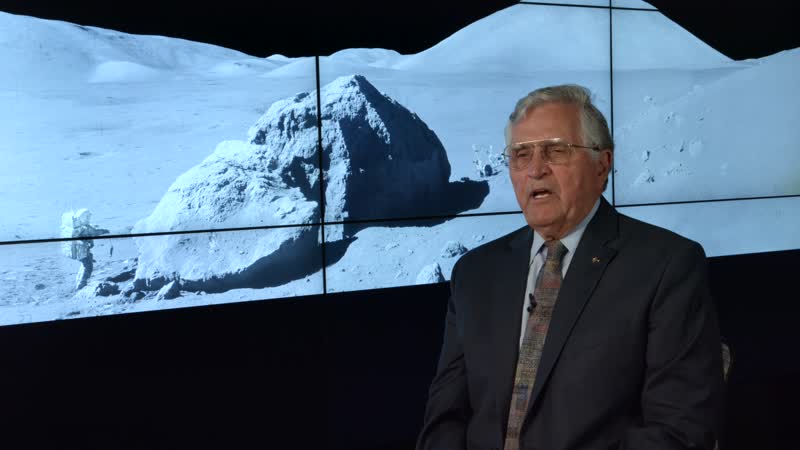
0:00Later this year, Apollo 17 astronaut and geologist Jack
0:03Schmitt will mark forty-five years since his first steps on
0:06the moon in December 1972. Those footprints left an impression on
0:10both the moon and on Schmitt.
0:16“No matter how much preparation
0:17you have for experiences like stepping on the moon, it’s going
0:23to be more than you ever anticipated.” Schmitt was the
0:26first trained field geologist to observe the moon up close and
0:29personal, and he found himself discovering unexpected things
0:32with every step. “Every rock that we examined had something
0:35new that I didn’t expect. And surprises are what geologists
0:39like. That’s why you’re exploring – to see the things
0:43that no one has ever seen before.” Schmitt spent a
0:45combined twenty-two hours outside of the spacecraft during
0:48his three excursions on the moon. Before his own trip,
0:51Schmitt trained other Apollo astronauts. Sharing with them
0:54his in-depth knowledge of field work. “The main thing was to
0:57expose them to as many different geological experiences as we
1:01possibly could. Get them out in the field – don’t let them sit
1:04in the classroom.” He treated training scenarios on Earth the
1:07same way he would if they were on the moon. Including simulated
1:10equipment, backpacks and cameras strapped to the front of
1:13spacesuits. Astronauts could then focus on what differences
1:17in the rocks they were seeing, and what rock samples were best
1:19to collect. Essentially giving them the fundamental field
1:22geological experiences that they needed to succeed. The four or
1:25five days per month Schmitt spent training astronauts in the
1:28field really did made a difference. “The quality and
1:31diversity of the Apollo sample collection, independent of
1:35Apollo 17 where you had an experienced geologist, the
1:39quality and diversity of that sample collection is just
1:42remarkable.” Fortunately, the current
1:44Lunar Reconnaissance Orbiter mission, or LRO, is changing
1:46the game; bringing back high- quality photography of the moon
1:50that Schmitt only wished he’d seen before his own trip. “The
1:53Lunar Reconnaissance Orbiter program now has provided us with
1:57a much, much higher resolution suite of photographs for any
2:00future astronauts.” What we learned from the Apollo missions
2:03helped lay the groundwork for LRO, and LRO will help guide
2:06future explorers. “Every new environment in which a geologist
2:10works is usually very different than the last, but you have
2:14learned things from your previous experiences that do in
2:18fact enable you to maximize the value of your new experience.”
2:23Schmitt has his fingers crossed for future moon exploration, a
2:26landscape he considers holds answers to many questions about
2:29the early solar system. “You can hear people talk about it, but
2:32you can’t absorb it until you’re there.”
 ▶ Watch on Afoli
 Wood chopping1:42
 Testing the Dragonfly drone in the dunes2:25
 Sunset over Bangkok, timelapse4:53
 The Amazon canopy in laser data2:01
 A gas carrier transits Porpoise Bay2:40
 The Dog Factory (1904)4:29
 Hobby horse laughs6:41
 The rapids and falls of Ohiopyle2:56