0:00[ Music ]
0:02[ Background music ]
0:02>> The bulk of the engineering footage required
0:04for any given shuttle mission is taken during launch and ascent.
0:08However, a significant effort is dedicated
0:10to documenting the orbiter landings as well.
0:12What we're going to see is two clips
0:15from the Kennedy Space Center shuttle landing facility,
0:17captured on 35-millimeter film at a hundred frames per second.
0:21These are fixed camera mounts showing the approach
0:23and landing of the orbiter.
0:24Now, our first clip shows Atlantis on final approach,
0:27returning from the STS-122 mission.
0:29It's important to note that space shuttles were designed
0:32to land as gliders, without power,
0:34so they had no opportunity to go around.
0:36As a consequence, the mission commander only had one
0:38opportunity to get the vehicle down on the runway,
0:40so managing altitude and kinetic energy, to account for this,
0:44was absolutely critical for a safe landing.
0:46Now, in final approach, orbiters have often been referred
0:49to as flying bricks.
0:50They come down quite fast.
0:52And just before landing, they nose down 19 degrees and descend
0:55on a glide slope seven times steeper and 20 times faster
0:58than a commercial airliner.
0:59At around 2,000 feet in altitude,
1:01the commander flares the vehicle.
1:02And just 15 seconds prior to touchdown,
1:04the landing gear is deployed.
1:06This camera gives a great overall view of the vehicle
1:08on approach and for the most part is intended
1:10to document the performance
1:11of the landing gear and its deployment.
1:13The analysis teams will look for any debris
1:15that might be liberated, as the gear doors open.
1:17And they'll also look at some of the other things, like sink rate
1:20of the vehicle and orientation on final.
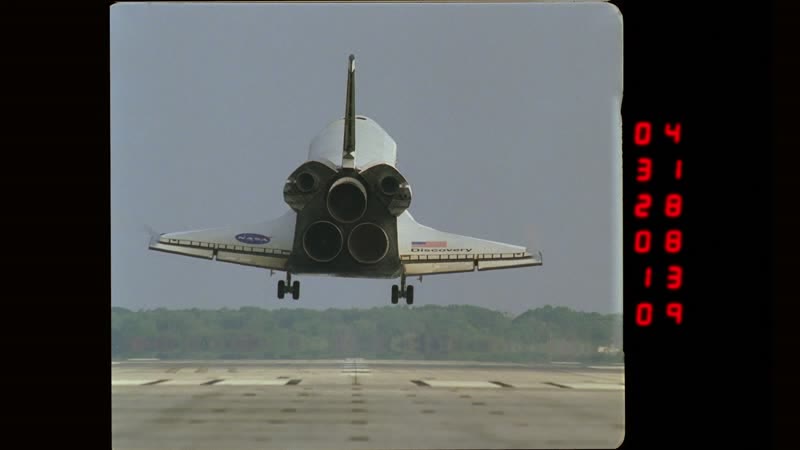
1:24>> On this next camera view, we're actually now looking
1:27at Discovery, not Atlantis,
1:29and Discovery's coming back from STS-131.
1:32Basically, we wanted to pick some of the best-looking clips
1:34for this production, and as a consequence,
1:36they weren't the same mission.
1:39Interestingly enough, these two clips were taken almost two
1:42years apart, but they were nearly at the exact same time
1:44in the morning -- 9:07 and 9:08,
1:46just a minute apart from one another.
1:48The shuttle landing strip is an amazing 15,000 feet long,
1:52so those trees you see in the background are
1:54over three miles away.
1:55Look at the wing tips.
1:57You can see some of the vortices shutting off there
1:59and causing kind of a neat atmospheric distortion.
2:02And you can see the crosswinds pushing the vehicle
2:05around a little bit.
2:06Here you see the smoke from the tires getting caught
2:09up in the wing vortices, causing sort
2:12of a sideways tornado effect.
2:14You can see the actuator speed brake in full deployment there.
2:19There's the drogue chute coming
2:20out to pull the main drag chute out.
2:22You can see some hardware flying across the runway there.
2:25The debris team will have to go out and get that hardware later.
2:29All that has to be accounted for.
2:31And if you look at the drag chute,
2:34it's not fully deployed yet.
2:36You'll see it incrementally deploy here.
2:38They do that so it doesn't rip the chute off right away.
2:41So as the speed of the orbiter decreases, the deployment
2:44of the drag chute increases.
2:46There's one of the service vehicles.
2:49There's actually quite an armada of service vehicles
2:51that chase the orbiter down the runway, as soon as it flies by.
2:54Kind of an interesting fun fact: The debris teams --
2:58Bob, Armando, Scott, the guys from one of the commentaries,
3:02actually drive out and drive in the opposite direction,
3:06down to the other end of the runway,
3:07where they will begin their walkdown by foot
3:10of the entire runway, looking for debris, collecting anything
3:13that doesn't belong there
3:14and may have fallen off the orbiter during landing,
3:16and getting some of that hardware
3:18that was liberated during the chute deployment.
3:21[ Music ]
 ▶ Watch on Afoli
 Wood chopping1:42
 Testing the Dragonfly drone in the dunes2:25
 Sunset over Bangkok, timelapse4:53
 The Amazon canopy in laser data2:01
 A gas carrier transits Porpoise Bay2:40
 The Dog Factory (1904)4:29
 Hobby horse laughs6:41
 The rapids and falls of Ohiopyle2:56