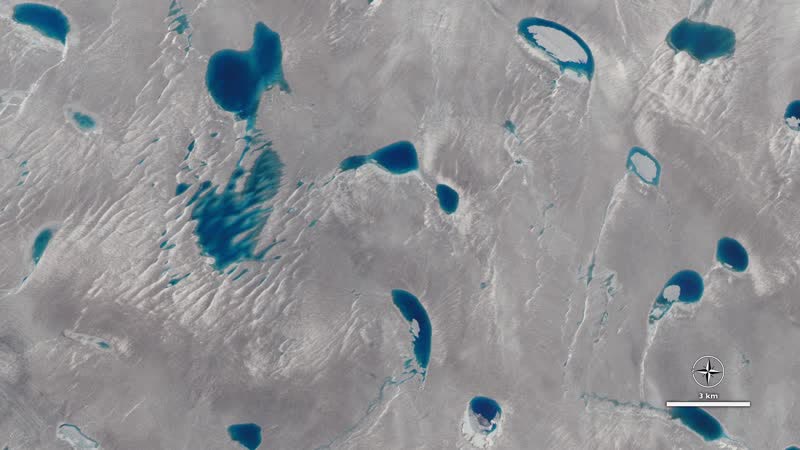
0:00The lakes forming on the surface of Greenland are storing a large amount
0:04of meltwater throughout the season.
0:07Sometimes you see really shallow, kind of lagoon, almost snow swamp sort of thing,
0:12all the way up to lakes that are almost 30 feet in depth.
0:17As a glaciologist, I am looking at this and
0:20I see bright ice, some darker ice,
0:24that happens to have more dust in it. I see really bright snow
0:28I see the lakes. You can see kind of a network structure
0:31where they are draining together.
0:34So intuitively, you see this beautiful blue color, and you know the darker the blue, the deeper the lake.
0:41Which is nice, but we want to be able to quantify that.
0:44So imagine that you're a little beam of light. You get emitted by the sun,
0:48you hit the surface of the lake. As the light goes through the lake, some of it is absorbed by the water
0:53and a little bit of it gets scattered back.
0:56Then the light hits the bottom of the lake and a bunch gets return reflected,
1:00goes back through the column of water in the lake,
1:04and that is what Landsat can see.
1:07So we need to be able to understand how much energy is being absorbed by the water
1:13what the reflectance of the bottom of the lake is,
1:17and what proportion of light is being scattered back by the water.
1:22Once we have those three pieces of information
1:25and what the brightness that particular pixel is,
1:28then we can say how deep the water is in the lake there.
1:33These lakes are darker than the ice around them so they are going to start absorbing
1:36more energy from the sun and melt more.
1:39A little bit of melt concentrates in one place,
1:41and then melts more, which melts more, and it's a feedback mechanism.
1:46And when the lakes get big enough they can force open fractures
1:50that then drill all the way down to the bed of the glacier,
1:54transporting this water to the base where it can temporarily speed up the flow of the ice.
1:59And so we're interested in the lakes
2:02because they might be important for speeding up the ice sheet.
 ▶ Watch on Afoli
 Wood chopping1:42
 Testing the Dragonfly drone in the dunes2:25
 Sunset over Bangkok, timelapse4:53
 The Amazon canopy in laser data2:01
 A gas carrier transits Porpoise Bay2:40
 The Dog Factory (1904)4:29
 Hobby horse laughs6:41
 The rapids and falls of Ohiopyle2:56