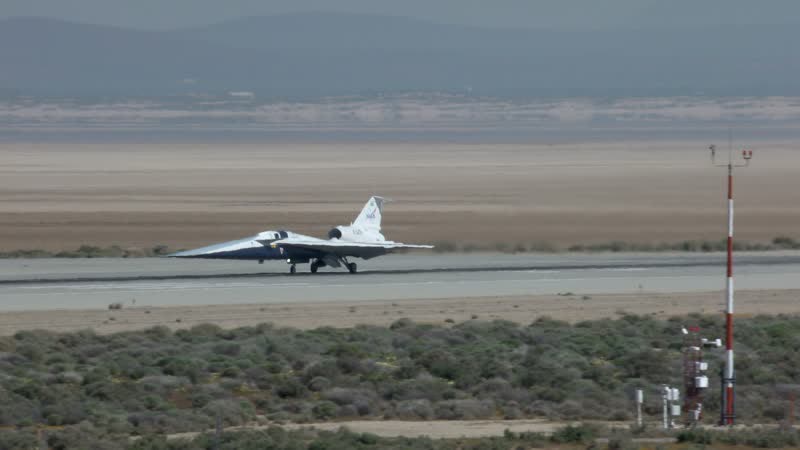
1:50Brake release. Air speed is alive.
1:58Male.
1:58Nose wheel steering is off.
2:01Looking good.
2:04Pulling right.
2:07And 143
2:09airborne.
2:15Leaving the gear down.
2:45Three down and locked. Clean.
2:48Cleared Chase.
2:51SPORT, NASA 859 passing 5700
2:55NASA 859 SPORT, radar contact.
3:16And Control is ready for takeoff.
3:25Six. Seven. Eight.
3:2930. 41,
3:33150, 160. Leaps right off the ground.
3:37[inaudible]
3:42Nose up to keep the air speed under control.
3:48Some amount of obstruction.
3:4910,000.
3:50[air traffic control chatter in background]
4:09Control, rolling out here to the east.
4:17There’s full right pedal.
4:23[inaudible]
4:28In the room.
4:29Thumbs if
4:29You're good for the gear retraction,
4:32Chase, call ready. We’re ready.
4:36Gear in three, two, one. Now.
4:43Okay, it does pitch up a little bit.
4:44Holds speed just fine.
4:47Clean and dry.
4:50Settings are verified.
4:51You are cleared.
4:51to arm and run.
4:54He’ll turn into us and bank away.
5:08Run, run!
5:11One potato
5:13Two potato.
5:14Okay.
5:18Point complete.
5:19Stand by. Reviewing.
5:21Cleared to arm and run.
5:37One potato. Two potato
5:44Point complete.
5:44Standby. Reviewing.
5:47You’re cleared
5:48Left side flip, slow release .
5:51Copy. Left, slow.
6:03Three quarters.
6:06Full.
6:08Slowly backing out.
6:13half.
6:16Point complete.
6:49Test. Control.
6:50Good maneuver. Card complete. Moving to car five.
6:52Set up for climb up to 32K, .7
6:56Target 241 KEAS.
6:59Copy.
7:01Control’s ready for the climb at 250 to 260.
7:04Capturing point eight.
7:07Okay, Test copy.
7:11Starting up.
7:14250 to 260
7:19And test.
7:19Expect potential wind shear in the 12 to 14 K region.
7:23Copy.
7:27Chase is
7:27showing 291, 32060, .80MACH
7:36Copy.
7:37Ready to go to 43K.
7:38Okay.
7:39Coming up to 43K.
7:46There's 43K
8:24Clear to accel.
8:31Chase mumbling .94.95.
8:47Test. You are cleared roller coaster
9:01Point complete.
9:31Point complete.
9:34[inaudible]
10:24Okay.
10:25Let me go and reset.
10:26Bingo to 2.7
10:29copy.
10:29Resetting. Bingo.
10:31We’ll call that Joker.
10:55K, red light in the handle. Brake degrade.
11:00Three green.
11:02FVS coming out.
11:05Control shows program five in progress
11:19Test. Control, when able.
11:21Fuels requests. Cross feed.
11:23Valve closed.
11:53NASA 859 contact Tower.
12:11NASA 859 Flight,
12:13Runway 23Left. Wind calm. Cleared for the option.
12:15Traffic is on final. Full stop.
12:18In sight.
12:19NASA 859 copies. Traffic iin sight.
12:23NASA 859 Flight, Runway 23L. Wind 110 at 3. Cleared for the option.
13:19be a little crosswind.
13:20Maybe?
13:26Good transition.
13:28Good transition.
13:31Thank you.
14:00The big successes
14:01from block one, we're getting the airplane airborne again,
14:04retracting the gear, showing that it flies well with both the gear up
14:08and the gear down
14:11so we started off block one with just one flight in the first week,
14:15and then we worked up to two flights in the same week.
14:19We've now worked up to doing two flights in one day
14:23and up to four flights in a week.
14:28flight test is all about a build up approach.
14:31We don't want to just go out as fast as we can on the first try.
14:34So we step carefully.
14:36We go a little bit higher. We go a little bit faster.
14:38Each one of those test points expands the envelope.
14:46We also go
14:47slower and lower, because sometimes that's a little more hazardous.
14:51So we get the airplane to its minimum speed and we've achieved
14:55that as well on block one.
14:59For higher and faster in block one, we got again
15:02got up to 43,000ft and about 2.96 mark.
15:06The next step in the next phase, of course, will be taking in supersonic.
15:13So the flight test
15:15maneuvers we do, such as bank to bank rolls or side slips, are all designed
15:20to prove that the airplane is safe to fly in a normal envelope
15:26down the road, when we're
15:27flying it around the country, we don't have to worry about
15:31whether I can roll to the left and pull hard on the stick.
15:35All these things have been proven in flight test with the control room
15:38backing us up the whole way.
15:43So we've spent years flying our simulator.
15:46So we have an idea how we think the airplane is going to fly,
15:50from a handling quality standpoint, it feels a lot like the simulator.
15:55Big differences. The simulator doesn't have motion.
15:57So now we get to feel all the the motions of the aircraft,
16:01the oscillations, vibrations, things that you get in in a real airplane.
16:06Performance wise, our airplane actually seems to be going
16:09faster and climbing better than the simulator even predicted.
16:12So that's exciting news.
16:17Every time we go fly this airplane, we learn more about it.
16:20We learn something new.
16:21We also just learn how to be more efficient.
16:24So our maintenance crew is getting very familiar with the airplane.
16:27They're able to process the airplane after landing
16:31and turn it around for the next flight in shorter and shorter time spans.
16:38So during envelope expansion, every flight
16:41we go out and we do something that hasn't been done yet with the airplane.
16:45And those are the test cards or test points that we're trying to reach.
16:48So every day we prove something new.
16:50The airplane can can go higher, it can go faster, or it can go slower.
16:55But every everything we're doing is new.
16:58And that's the point of envelope expansion.
16:59And once we've expanded the envelope and there's nothing new left to do, then
17:04we're done and the airplane is ready to go.
17:10The success of block one
17:12was expanding both in altitude and airspeed
17:17to prove out the system performance, as well as the vehicle handling qualities.
17:22And validate that it's matching predictions to give us confidence
17:26to proceed even further.
17:28And speed and altitude as we proceeded to supersonic test flights.
17:36you have to prove the air worthiness of handling qualities of the aircraft
17:39that each test point along the way to give you the confidence
17:43that you can continue to expand to both higher and faster
17:46speeds?
17:50Milestones
17:51accomplished in block one include flying up to an altitude of 43,000ft,
17:56reaching Mach 0.95
17:59just before supersonic flight.
18:03Landing gear transitions to prove the airworthiness
18:06and the vehicle systems, both in the up and away configuration
18:10with gear up and the, landing gear down configuration.
18:16we're doing
18:16maneuver development sessions to make sure that the pilots and the test team
18:21know how we're going to go fly certain maneuvers for an upcoming mission.
18:24We have SIM rehearsals in the control room to make sure the control room team
18:28is fully trained.
18:30The maintenance crew is making sure the jet is completing all of its routine
18:34inspections and making sure the jets ready and airworthy to fly the next mission.
18:39We have the flight test engineering team putting all the products together
18:43to go support the actual flight test in terms of briefings and test scores.
18:48And then we actually have the day of execution, where we go
18:50through briefings and the flights themselves and the debriefings.
 ▶ Watch on Afoli
 Wood chopping1:42
 Testing the Dragonfly drone in the dunes2:25
 Sunset over Bangkok, timelapse4:53
 The Amazon canopy in laser data2:01
 A gas carrier transits Porpoise Bay2:40
 The Dog Factory (1904)4:29
 Hobby horse laughs6:41
 The rapids and falls of Ohiopyle2:56