0:00The next couple of clips you're going to see are extra scenes
0:03that effectively didn't make it into the production cut
0:05and the reason being that we had to keep the time down to
0:07around 45 minutes or so.
0:10But these are long range tracking scenes
0:12with the exception of the last one
0:13which is a composite scene you'll see in a few moments.
0:16But they all deserve attention
0:19because of the significant technical achievement that's
0:21involved with capturing these scenes, these images
0:25that you're about to see.
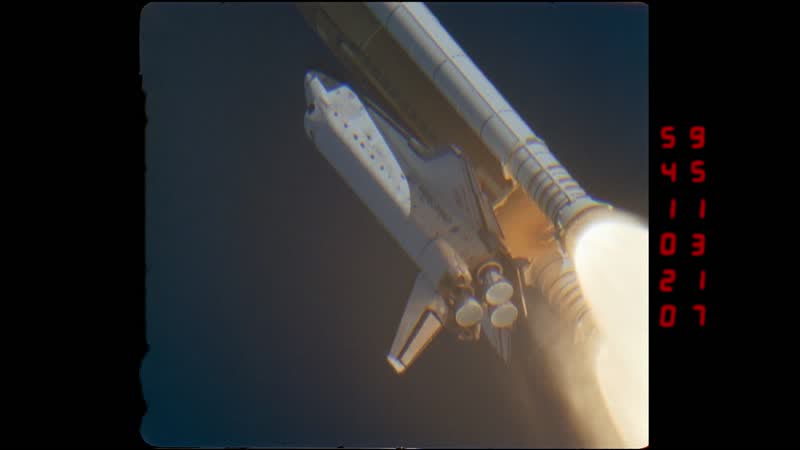
0:27Okay, the clip that you're about to see is Echo 207 and this
0:31from Playalinda Beach Domes.
0:34It's about 7.75 miles north
0:38of the pad right along the beach road
0:40within the Cape Canaveral National Seashore.
0:44Now, this image has been inverted.
0:47When it's captured it's actually captured upside
0:50down to the viewer because of the type
0:54of lens that's used to capture it.
0:57The tracker that's capturing
0:59and tracking this image is a dome system,
1:02it's just an object altitude measurement system.
1:06This is a very long focal length lens somewhere on the order
1:10of approaching 500 inches in focal length.
1:12Yeah, these are effectively telescopes, right?
1:14Telescope lenses, that is correct.
1:17And these are part of the Cape Canaveral Air Force Station,
1:21Patrick Air Force Base, range safety assets.
1:24These trackers are used primarily
1:27to ensure the safety of the range.
1:29Another distinguishing feature of this image,
1:32besides the exceptional optical quality,
1:36is the focus is actually driven by range data to keep the image
1:42in focus as it passes through the various distances
1:45that you'll see here.
1:46Yeah, it's amazing to see the absolute clarity that you get
1:50from such a long distance away.
1:52Take notice of the body flap.
1:54As you can see it's vibrating
1:55and it's just right below the space shuttles main engines
1:57on the back of the orbiter there,
1:59and you can see a significant vibration in that.
2:02Of course, we knew about that in the design process.
2:05We knew that that body flap would be undergoing that kind
2:07of deformation, but it just sort of hints
2:12at the enormous loads the vehicle is subject
2:15to on the way up into space.
2:17And actually, if you watch carefully,
2:19you can see the vibrational mode of that for the technical people
2:22in the viewing audience.
2:24You'll actually see the vibrational mode of that change
2:27as it goes through a couple
2:28of different parts of its flight regime.
2:32See the plume sort of expanding now if you watch the back
2:35of the external tank underneath the engines.
2:37You can see it's starting to brown up a little bit.
2:40That's because of the exhaust gas recirculation coming
2:43out of the boosters starting to heat up that foam,
2:46that insulating foam that's on the bottom of the tank.
2:48Nice lighting, these are STS-124 again.
2:51Yes. Ah, so, beautiful, beautiful lighting in the Septor
2:55in this evening sun and kind of see it here and as
2:58with all the 124 shots, they were second to none.
3:03And one of the advantages of the focal length that these lenses
3:07on these dome systems provides is the capability to look at,
3:12in many cases, SRV separation.
3:14This clip here is Echo 204 and this is, this camera is
3:21at Patrick Air Force Base, which is about 31 miles south
3:25of the pad, just due south of the pad.
3:28Again, this is like Echo 207-- is a dome system--
3:32so it's an object attitude measurement system.
3:35And this is a very long focal length lens approaching
3:38between 400 and 500 inches.
3:40I'm not sure exactly what the focal length is.
3:42The image would be inverted and because of the design
3:46of the lenses, it's a telescope lens system.
3:50Yeah, it's really amazing, just like the other one we talked
3:53about a few minutes ago.
3:55So, the solid rocket boosters as we mentioned
3:58in the primary production on this disk separated
4:01about 29 miles in altitude and you have enormous detail.
4:06I mean you can make out some of the rings on the boosters here.
4:08It's just fantastic detail.
4:09Were going to see SRV separation in just a few seconds.
4:13And the boosters don't actually flame out, they just go
4:17to a neutral thrust condition.
4:19And once they aren't generating any thrust relative
4:22to their mass, they obviously don't have any use anymore
4:25for the vehicle so they jettison them via these little miniature
4:30boosters, if you will, called booster separation motors.
4:32And that's the big cloud you see, as they detonate these,
4:35you'll see this big cloud that sort
4:36of engulfs the orbiter and the tank.
4:38And the boosters are sort of safely moved back away
4:43from the orbiter and the tank
4:45so there's no possible conflict or impact.
4:52Kind of a nice shot of the plume there.
4:55The further they get up into the vacuum
4:56of space you see more expansion of the plume as it comes
4:59out of the SSMEs, the space shuttle main engines,
5:02and the boosters themselves.
5:04So, we're gearing up for booster separation there.
5:06You see it-- an enormous cloud of exhaust coming
5:10out of those little separation motors.
5:12They have four of them on the front
5:14and the back of the booster.
5:15And you can see that the boosters actually,
5:18as I mentioned, don't go out: they're still burning.
5:20There's still quite a bit of fuel on the inside
5:22of those boosters and they will actually flame all the way back
5:27down into the Atlantic Ocean.
5:28They'll chug; they sort of puff on and off.
5:31So, they sort of give you the impression they're falling back
5:35down to Earth at this point but they actually have
5:37about 15 more miles to go up in the air before they peak
5:40and turn around and come back to Earth; and then they're rescued
5:44by divers out in the Atlantic Ocean and brought back
5:47and recycled for future missions.
5:52This is Echo 217 and this camera is up at Appollo Beach
5:56which is apart of the Cape Canaveral National Seashore
5:59and this camera is about 20 miles from the pad
6:03when the vehicle lifts off.
6:05It's a really an amazing view.
6:07The focal length on this camera system is about 360 inches.
6:12It's fairly long focal length
6:15and it's using the Kineto tracking mount
6:18for the tracking system that keeps up with this.
6:21So this is manually operated by the tracker operator.
6:24Looks like we're flying through a lot of haze there
6:27on this particular day, there's probably some clouds,
6:29long distance as you mentioned, between the camera operator
6:33or the camera itself and the vehicle.
6:35And so there's a little bit of haze and you can see that,
6:39but still an amazingly clear image.
6:41If you look at the bottom of the tank, you can see it's starting
6:43to flame on a little bit there, which as we mentioned
6:47in the primary production; that this is a known phenomenon
6:52as the hot exhaust under the boosters
6:54and the main engines sort of re-circulates back around
6:58and touches that tank.
7:01And in just a little while longer,
7:04we're going to see some booster separation shots.
7:06And in the main video there was an image
7:14from this particular tracking site,
7:16but it was a high-definition video using 150-inch lens,
7:20and this is the film companion to that.
7:23Right, right.
7:23There's multiple cameras--
7:25up to four on one camera operation system--
7:28that one operator can control.
7:30So, if you go back and look at the,
7:34keep track of Kevin's callouts for what camera site we're
7:37at you can correlate that.
7:39Great slow motion shot of the booster separating just
7:41like the shot that we saw a moment ago.
7:44See the boosters falling back, safely pushed away
7:48from the orbiter and the external tank,
7:51and on their way back to Earth.
7:53Their total ride is 400 seconds from lift off to splash
7:57down - it's 400 seconds.
7:59They're actually in the water before the vehicle even gets
8:02up into orbit.
8:09What you're seeing here is two camera views
8:11that are actually composited together.
8:13Matt will talk about that more in a second.
8:15But this is from CS6, 1200 feet.
8:18The camera is from the vehicle,
8:20and this is a tracker that's remotely operated by an operator
8:23in the launch control complex using a track ball.
8:26Yeah, what we did was we used some software to actually sort
8:31of try to track these two images together,
8:33to make them look more aligned with one another, if you will,
8:38and it did a pretty good job, and that's why you see
8:40that line moving up and down is that the key frames
8:43that we're trying to hold together there sort
8:46of give you an extended view or panoramic view of the vehicle
8:50as captured by these two cameras.
8:51You can kind of see some of the paper, by the way,
8:53coming off there as the vehicle starts accelerating.
8:56Those are those paper covers
8:58that cover the reaction control motors on the vehicle.
9:01Going into the roll program, the software kind
9:05of looses the ability to track, you'll see it bounce
9:07around a little bit there,
9:08but it's actually a very beautiful shot,
9:10and the tracking will stop in just a few moments
9:14and the vehicle will fly out of the frame.
9:15And I found that to be actually a particularly nice shot--
9:19it's not seen too often in tracking.
9:21And Kevin, you may want to mention, you know,
9:25that this shot really only is concerned
9:28with the first part of the launch.
9:29Yeah, yeah, I'm sorry, Matt.
9:31The first 18 to 20 seconds is really what this shot is
9:36intended to be looking at as the vehicle clears the pad
9:40and clears the tower structure about 200 to 300 feet or so.
9:44So, this is a nice scene to end our extra features on.
9:47We hope you enjoyed it.
9:48Hope you enjoyed the commentary
9:50and hope you enjoyed the production overall.
9:53Thanks.
 ▶ Watch on Afoli
 Wood chopping1:42
 Testing the Dragonfly drone in the dunes2:25
 Sunset over Bangkok, timelapse4:53
 The Amazon canopy in laser data2:01
 A gas carrier transits Porpoise Bay2:40
 The Dog Factory (1904)4:29
 Hobby horse laughs6:41
 The rapids and falls of Ohiopyle2:56