0:00My name is Caye Johnson.
0:02I went to work at NASA Ames in 1964.
0:06I was a biologist in the
0:07Life Detection Branch and I worked in
0:10the Lunar Biological Laboratory which was
0:13specifically designed and built
0:15to look for microbial life
0:17in the Apollo 11 samples.
0:19So in order to go into the lab, we would have to
0:22walk through an air shower, where everything would
0:25get blown off of us.
0:27You know we had to be really careful that
0:29we didn't introduce a microbe into the samples
0:32and then falsely say that we'd found it.
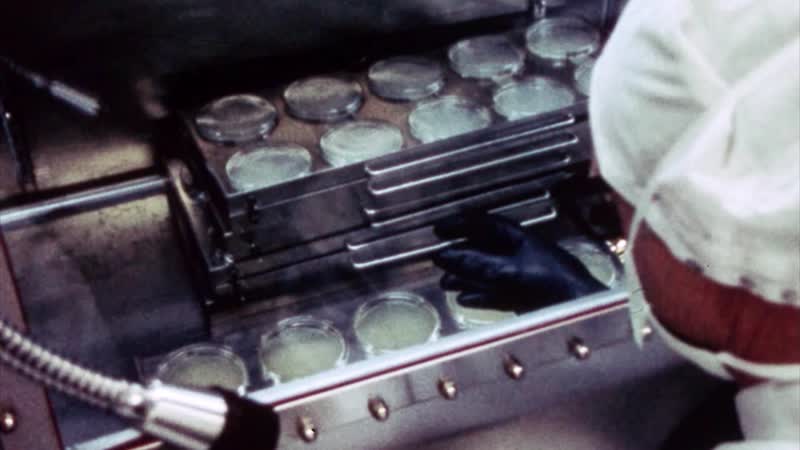
0:35We were culturing the samples
0:37under 300 different environments.
0:40And there were ten petri dishes for each environment.
0:44Typically the way you make petri dishes
0:46is you have agar with different kinds of
0:49chemicals in it, depending upon what it is
0:51you're trying to culture.
0:52In one of the sequences, you can see the guy
0:54sort of running like a little pump and then
0:56he's going from petri dish to petri dish
0:58and that's just putting a certain amount of agar
1:01in each petri dish.
1:02You would dump the sample in, like there, so that
1:04it falls onto this disk right underneath
1:07where the funnel is.
1:09And then you see them attach a hose
1:12and that hose is high pressure gas.
1:15Scatters it, so that you get more uniform
1:18distribution of the lunar sample over the surface
1:21of the petri dish.
1:22And then, you would take the petri dish and put it
1:25underneath the microscope.
1:27We only looked at the petri dishes twice a week.
1:30You know, sometimes it would be me,
1:32sometimes it would be some of the other women.
1:34And that's how we examined the petri dishes
1:37to see if there was anything growing on them.
1:41No signs of life were ever found
1:44in the lunar samples.
1:48The research paved the way for later work
1:51in astrobiology and the search for life on Mars.
 ▶ Watch on Afoli
 Wood chopping1:42
 Testing the Dragonfly drone in the dunes2:25
 Sunset over Bangkok, timelapse4:53
 The Amazon canopy in laser data2:01
 A gas carrier transits Porpoise Bay2:40
 The Dog Factory (1904)4:29
 Hobby horse laughs6:41
 The rapids and falls of Ohiopyle2:56