0:00[ Sound Effects ]
0:09The Apex 3-2 TAGES experiment is a follow on, in a way,
0:14a follow-on experiment
0:15of our earlier TAGES experiment that flew on Apex 1.
0:18The experiment is, uses the same organism,
0:22a Arabidopsis thaliana -
0:23the model of the organism of the plant world.
0:27What we've done with this experiment is we've engineered
0:29them with a number of different green fluorescent reporter genes
0:33that we're going to be following specific expression patterns
0:35using the element microscope, and in addition,
0:38a number of the Arabidopsis lines that we're using
0:41in the Apex 3 experiment are mutants in certain genes
0:46that we found were important the last experiment
0:49that we did in spaceflight.
0:50For instance, in the previous experiment,
0:51we found that a number of the genes that are involved
0:54in cell wall remodeling are the ones
0:57that are engaged in spaceflight.
0:58So one of the things that we wanted to do
1:00with the current experiment is specifically look
1:03at particular mutants in a Arabidopsis
1:06and also different types of reporter genes that allow us
1:10to ask some of the questions that arose
1:13from the answers we got in the last experiment.
1:15As a laboratory, we are plant and molecular biologists,
1:18we're interested in spaceflight, and as a novel environment,
1:21as something that's outside the evolutionary experience
1:25of plants, and what the Apex 2 experiment does,
1:28Apex 3-2 experiment does, is look at a Arabidopsis thaliana
1:33and how it responds both at the molecular genetic level,
1:37as far as what genes are turned on and turned off biochemically,
1:40and also using live imaging with the LMM,
1:44Light Microscopy Module, to look at specific reporter genes.
1:47We've engineered to give us specific locations
1:50for which these genes are happening in real time.
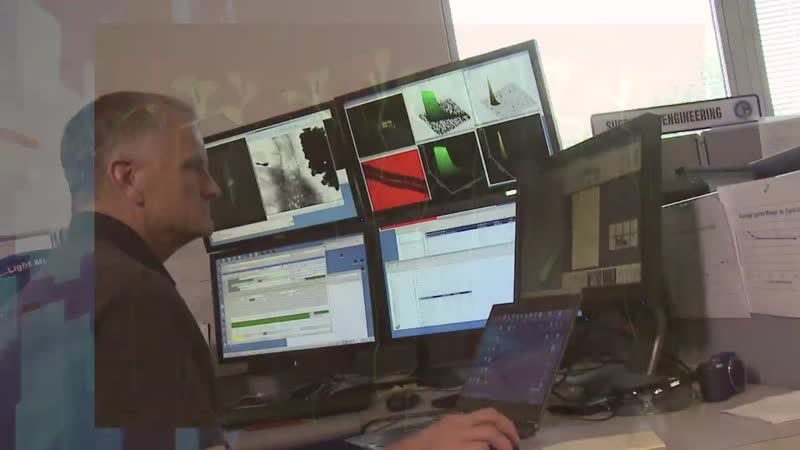
1:53We are using a new piece of hardware that is the LMM,
1:58the Light Microscopy Module, and what that allows us to do,
2:01in our first apex experiment,
2:02what we did is we used the green fluorescent imaging system,
2:05the GIS, that's on orbit in the ABRS unit,
2:08to collect real-time images of the entire petri plate
2:12that our plants are growing upon,
2:14and that gave us fluorescent gene expression data as well
2:16as root growth data and such, which was great!
2:19But what the LMM allows us to do is
2:21to take things a little step further, and we can now look
2:24at individual roots, not only at the macro level,
2:27but at the microscopic level.
2:29And not only just on the surface of those roots,
2:31but we can tunnel in a little bit
2:33by taking different focal planes of the same root
2:37and look deep inside the root tip to see
2:39which cells are expressing some
2:42of the green fluorescent protein genes,
2:44in which we're interested.
2:45And that gives us a whole new dynamic to ask, well,
2:49how are plants responding
2:50and where are those cells changing inside those roots?
2:53And that gives us a much more dynamic range
2:57of gene expression patterns on orbit
3:00than we were able to get before.
3:02The two space centers that we've worked with,
3:04Kennedy Space Center and the Glenn Research Center,
3:06work together because they have two different aspect
3:09of how they facilitate our experiment.
3:11Of course at Kennedy we have the launch.
3:13And what Kennedy also does is supports us in terms
3:16of the infrastructure and doing the ground control experiments,
3:21also doing the, all the pretesting,
3:24what we call the spaceflight, the science verification,
3:27the payload verifications, all that stuff is taken care
3:29of by Kennedy Space Center.
3:31Glenn Research Center comes into the deal
3:33because they have got the very specific type of hardware
3:36that we'd like to utilize on orbit, the LMM.
3:39So the Light Microscopy Module now allows us to take a closer
3:43and deeper look at some of the gene expression patterns
3:46that can be revealed by some of these fluorescent reporter genes
3:50that we've engineered into our experiment.
3:51So GRC handles not only the experiment itself
3:55from the imaging point of view, but it also has been very good
3:58about allowing us access to the people and to the ground unit
4:02for the LMM, both before, to tweak the systems
4:06and also test some of the new parameters
4:09that we'd like to explore.
4:10Part of what I find most exciting
4:12about doing what we would call space biology,
4:15is taking our biology, you know, the stuff that we live
4:20with on a day-to-day basis, our plants, ourselves, anything,
4:23is taking it to an environment that is,
4:26and I've said this before, outside our realm of experience,
4:29outside our evolutionary experience,
4:31and it is fascinating to me
4:34to see how a terrestrial organism functions
4:38in that kind of environment.
4:39And so, for me, that's part of the most exciting bit
4:42from the science end of things, is to see, you know,
4:45how the genes change, how the plants change, you know,
4:48how all of this comes together in adjusting
4:53to something new and something novel.
4:56It's also very exciting to be part of a pioneering group
5:00of going out and exploring new avenues of research,
5:04new environments, new platforms of doing this kind of research,
5:09and fundamentally, myself and humans in general,
5:12we're explorers, and I feel like this is what's next.
 ▶ Watch on Afoli
 Wood chopping1:42
 Testing the Dragonfly drone in the dunes2:25
 Sunset over Bangkok, timelapse4:53
 The Amazon canopy in laser data2:01
 A gas carrier transits Porpoise Bay2:40
 The Dog Factory (1904)4:29
 Hobby horse laughs6:41
 The rapids and falls of Ohiopyle2:56