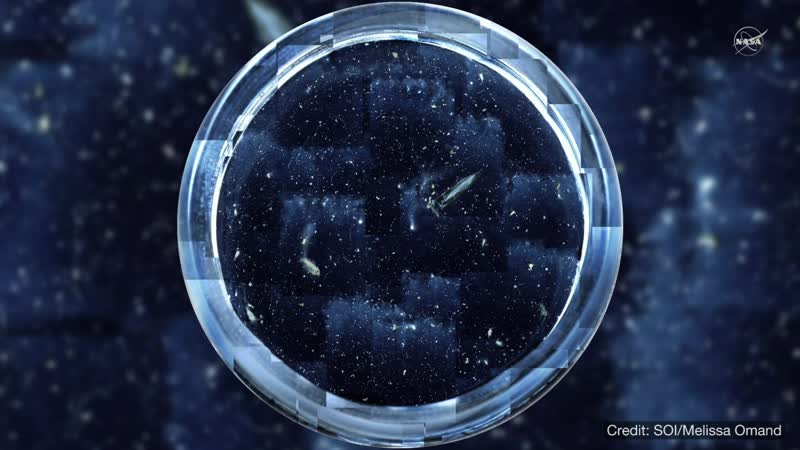
0:00Phytoplankton…tiny, mostly single-celled organisms
0:04that live in the oceans, creating energy for our ocean’s ecosystems.
0:08They’re eaten by zooplankton, slightly larger organisms
0:12that make a daily trek from the ocean’s sunny upper layer to its pitch-black depths.
0:17In this cycle, they drift through an important region,
0:21a dimly lit middle ground between light and shadow…an area scientists call
0:25the twilight zone.
0:29Enter the Export Processes in the Ocean from RemoTe Sensing, or EXPORTS project
0:33– a team of more than 150 scientists…from 29 different institutions…
0:38onboard two research vessels with a fleet of autonomous vehicles…
0:42traveling west from Seattle to study these phytoplankton.
0:46The team, made up of researchers from NASA, the National Science Foundation, including
0:51the University of California- Santa Barbara, the Woods Hole Oceanographic Institute
0:55and other university and agency partners, will deploy robotic explorers
0:59and instruments from the two ships to study the diversity of plankton in the ocean.
1:03The ocean absorbs approximately 1/2 of the carbon dioxide
1:08from Earth’s atmosphere. Like plants on land, phytoplankton take in this carbon
1:12and release oxygen. Their blooms can
1:16be seen in images taken from space. As the phytoplankton die or are eaten
1:20by zooplankton, that consumed carbon is exported into the twilight zone
1:25zone and stored there.
1:29in the ocean can help scientists understand the role the ocean plays in consuming,
1:33and sequestering, carbon from the atmosphere.
1:37In turn, understanding this can give insight into the ocean’s carbon cycle
1:41and how it helps regulate our home planet’s changing climate.
 ▶ Watch on Afoli
 Wood chopping1:42
 Testing the Dragonfly drone in the dunes2:25
 Sunset over Bangkok, timelapse4:53
 The Amazon canopy in laser data2:01
 A gas carrier transits Porpoise Bay2:40
 The Dog Factory (1904)4:29
 Hobby horse laughs6:41
 The rapids and falls of Ohiopyle2:56