0:05I'm Ryan Walker. I work here at the Cryospheric Sciences Lab.
0:10I work on computer simulations of the
0:13Antarctic and Greenland ice sheets.
0:15to project how much of the ice is going from
0:18land into the ocean because it's possibly
0:21an important contributor to sea level rise under climate change.
0:28My name is Christine Dyer.
0:29I'm researching sub-antarctic lake developments,
0:33so using numerical models to see how water
0:36builds up and depletes underneath the Antarctic ice sheets.
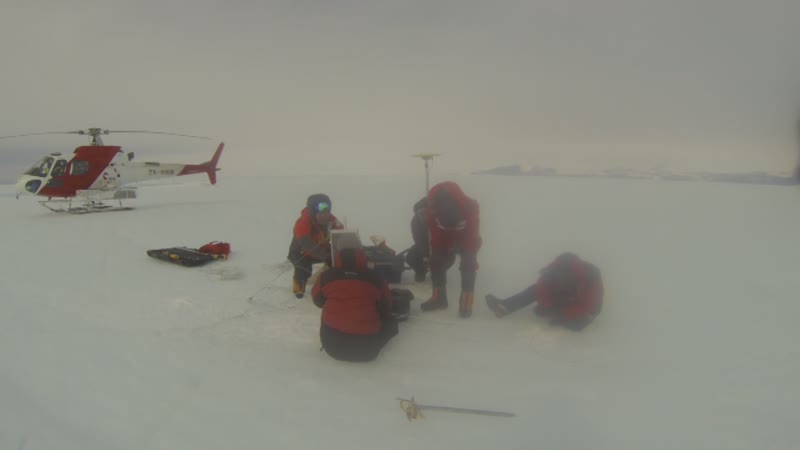
0:40So we went to the new South Korean research station
0:44Jang Bogo at Terra Nova Bay not too far from
0:49the United States McMurdo base.
0:52The Korea Polar Research Institute
0:54fed and housed us for five weeks and
0:57provided helicopters and worked with us.
0:59It was something that we absolutely could not have
1:02done without them.
1:04In this first study, we were looking at how the ocean
1:08tides affect the motion both horizontally and vertically
1:11of the Nansen Ice Shelf.
1:14Examining how the ice shelf responds to tides
1:17helps us get at the dynamics of how the ice flows and
1:23we're hoping will help future computer simulations.
1:28In order to get over to the Nansen Ice Shelf
1:33you fly over extremely dramatic cliffs,
1:36very large areas of ice cravassing.
1:39So it's quite spectacular on the way over.
1:44There was one particular moment, actually,
1:45when we first arrived to our tilt meter site.
1:47There was no wind at all and
1:48there was quite a lot of snow around.
1:50And the most poignant thing I think was the silence.
1:55When the helicopter shut down, nobody was talking.
1:57You could not hear a single thing and that's such
1:59an usual thing to be able to find in the world.
2:01No plane noises, no electricity noises, just absolutely nothing.
2:05And it was one of the most spectacular places I've ever been.
2:12The Antarctic ice sheet is flowing under its own weight
2:15spreading out from the center of the continent out
2:19to the edges and when it reaches the ocean
2:22it goes afloat as ice shelves.
2:25And where you have ice shelves
2:28that are in bays where the ice contact with the rock walls
2:33this friction acts to hold back the ice flow,
2:36so in some sense
2:37these smaller ice shelves are like corks.
2:40So as soon as you remove them, there's nothing preventing
2:45the ice mass from moving quick down.
2:47If these calve off, if these break off
2:49right back to where the ice is resting on land
2:52it can speed up dramatically and it's particular worry
2:55at the moment that the ice shelves around the Antarctic
2:57are going to break up and then we're going to see
2:58an unprecedented speed up in the ice coming out
3:01of the center of the ice sheet.
 ▶ Watch on Afoli
 Wood chopping1:42
 Testing the Dragonfly drone in the dunes2:25
 Sunset over Bangkok, timelapse4:53
 The Amazon canopy in laser data2:01
 A gas carrier transits Porpoise Bay2:40
 The Dog Factory (1904)4:29
 Hobby horse laughs6:41
 The rapids and falls of Ohiopyle2:56