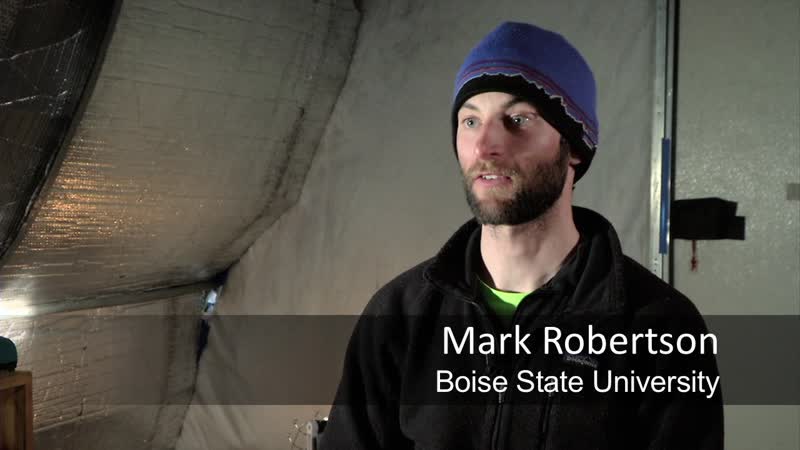
0:00The robot consists of two snowmobile tracks and two solar panels.
0:06It's not a robot for the sake of building a robot. But it's a robot for science.
0:15The climate is changing and snow is really important
0:18because it reflects a lot of the energy and heat from the sun.
0:23Places like Greenland which are covered in snow are very important.
0:28It's a large area of the earth's surface that's reflecting energy.
0:34Our main concern and main motivation to come over here was to be able to test it in the extreme environment,
0:40and temperature is definitely one of the most difficult issues.
0:45One thing is to be testing it in a controlled environment
0:49in a university, and a completely different thing is to come up here.
0:58When you get up here at -30 Celsius the wires, they just break in the cold, their so brittle.
1:13Biggest challenge was definitely trying to
1:16solve problems in the field.
1:20Out here when something breaks five miles out in the middle of the ice,
1:24it's very difficult to get the tools out and stay warm
1:28enough to be able to perform the repairs.
1:31We had to kinda go in shifts, work for a little bit, and then put your hands
1:36back in the gloves, or swing them, or put them in your armpits, or something.
1:40Warm them up, take a break.
1:42A repair that would take 10 minutes in normal conditions in a warehouse or a shop,
1:48it would take hours out there.
1:53What else could it be?
1:57Quick test - backwards first.
2:05Yes, we could have failed but we made it.
2:10It was kind of magic, to see it happen
2:13to see GROVER moving, every single time he went. It was great.
2:19GROVER represents the ability to collect an enormous amount of data.
2:22It would really revolutionize how much information
2:26we can get about the ice sheet on Greenland.
2:29It's really important to track the changes here.
 ▶ Watch on Afoli
 Wood chopping1:42
 Testing the Dragonfly drone in the dunes2:25
 Sunset over Bangkok, timelapse4:53
 The Amazon canopy in laser data2:01
 A gas carrier transits Porpoise Bay2:40
 The Dog Factory (1904)4:29
 Hobby horse laughs6:41
 The rapids and falls of Ohiopyle2:56