0:20[BACKGROUND NOISES]
1:37[ENGINES BOOMING]
1:455.7, 6.3.
1:49And 836, confirm land and position.
1:53It looks good.
1:54You're clear for the probing run.
1:56Copy here.
1:56Stand by.
1:58No, just go.
2:00Just go.
2:01Don't worry about that.
2:04[BACKGROUND NOISES]
2:25My name is Mike Frederick, and I'm the principal investigator
2:28for the shock-sensing probe.
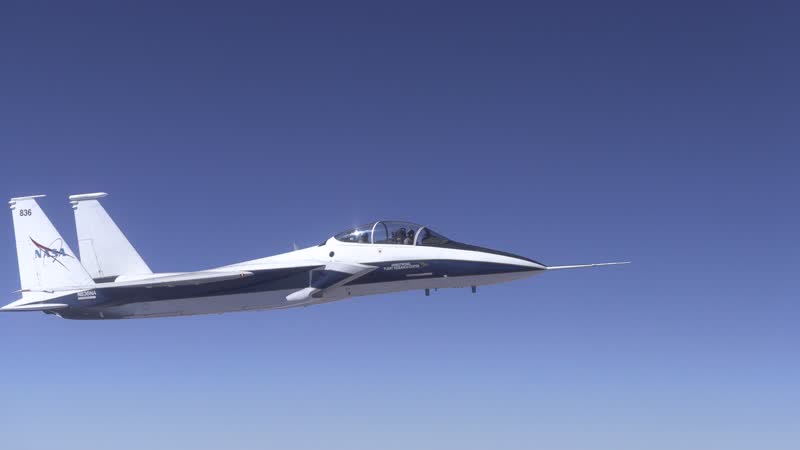
2:32The shock-sensing probe, it's a five-hole conical probe
2:35that's used to measure the near-field shock
2:37signature of X-59.
2:42So right now, we're testing out some new instrumentation
2:44that we have on the shock-sensing probe
2:47to see if it's going to be suitable for the probe
2:49in the near-field shock signature of X-59.
2:54Now, we're testing it out on the F-15
2:56by flying it up at altitude and probing another F-18, which
3:01is used as the target aircraft.
3:06Typically, the F-15 starts in trail
3:08and outside the shock signature of the target aircraft.
3:12And then we accelerate, so the probe pierces the shocks.
3:15And essentially, we go all the way through the shocks
3:18and we can see that in the control room.
3:19And then once we've seen that we've essentially
3:22pierced through the bow shock of the F-18,
3:24we will ask the F-15 pilot to decelerate and take
3:27another measurement.
3:31First point you need to look is the shocks near the aircraft.
3:33We need to understand the magnitudes of that shock
3:37structure.
3:38Because right now, they use wind tunnel tests, the recent wind
3:42tunnel test, and they've used computational fluid dynamics
3:45to estimate what that shock signature will look like.
3:50When they go to fly phase two, we will be in the control room
3:54monitoring the output from the shock-sensing probe
3:56and then providing data to the researchers that
4:00need that data.
 ▶ Watch on Afoli
 Wood chopping1:42
 Testing the Dragonfly drone in the dunes2:25
 Sunset over Bangkok, timelapse4:53
 The Amazon canopy in laser data2:01
 A gas carrier transits Porpoise Bay2:40
 The Dog Factory (1904)4:29
 Hobby horse laughs6:41
 The rapids and falls of Ohiopyle2:56