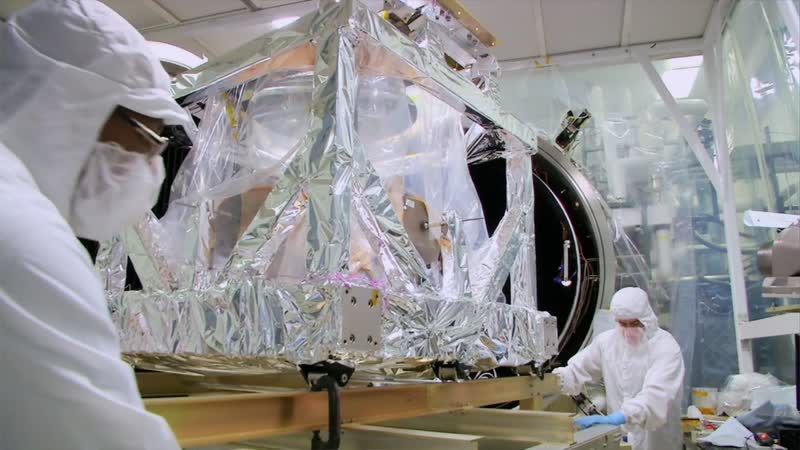
 ▶ Watch on Afoli
ICESat-2 measures Earth's ice
- Afoli Video
- 0 views
- Published 16 November 2026
- Duration: 1:55
Nature and wildlife: ICESat-2 measures Earth's ice. From the NASA Image and Video Library: a public-domain work of the US government.
0:00[Music]
0:04[Music] Markus: From satellite data,
0:08we have a very good handle of how our Earth looks like. We can see oceans,
0:12we can see the sea ice, we can see our forests, but it's much, much
0:18harder to measure how high things are on a global scale. Almost impossible.
0:22Neumann: ICESat-2 adds the third dimension, the elevation. Repeating measurements
0:26from ICESat-2 will allow us to measure changes in the ice sheets or in the
0:30ocean or in land. Markus: ICESat-2 is designed to measure
0:34the changes that are going on in the cryosphere, in the polar regions.
0:39Neumann: All the change is at the edges. Those are the steeply sloping parts of the glacier
0:43interact with the ocean, and that's where all the action is, that's where all the mass is being lost.
0:47Markus: In order to estimate the mass changes, we need to know the height
0:51of things. The mission, ICESat-2,
0:55carries a single instrument. It's called ATLAS, the Advanced Topographic
0:59Laser Altimeter System. Neumann: ATLAS sends out
1:03small pulses of laser light 10,000 times a second, and by
1:07measuring precisely how long it takes that light to go from the spacecraft
1:11down to the Earth and back up to the spacecraft allows us to figure out
1:15what the height of the surface is beneath ICESat-2.
1:19Markus: We need to measure the time of flight of a single photon, or a single laser pulse,
1:23with the precision of a billionth of a second. Neumann: NASA engineers had to come up with
1:27entirely new ways of measuring time very precisely.
1:31Markus: A billionth of a second translates to an elevation-change precision of
1:35just a few centimeters. Climate change is amplified in
1:40the polar regions. ICESat-2 is designed to measure those
1:44areas and will help us to understand what's going on with our planet.
1:48[Music]
1:52[Music]
 Wood chopping1:42
 Testing the Dragonfly drone in the dunes2:25
 Sunset over Bangkok, timelapse4:53
 The Amazon canopy in laser data2:01
 A gas carrier transits Porpoise Bay2:40
 The Dog Factory (1904)4:29
 Hobby horse laughs6:41
 The rapids and falls of Ohiopyle2:56