0:00[ Sound Effects ]
0:10Potential PIs will speak with me when we evaluate their science.
0:16The environment of the space station is extremely sensitive
0:20to any sort of introduced chemicals.
0:23All sample compositions will be evaluated
0:25by the International Space Station Environmental Safety
0:28Group and Johnson Space Center Toxicology
0:31to evaluate any possible toxicity of your samples.
0:35Your samples will be evaluated by the EQUIS group
0:38or the Environmental Safety's group to make sure
0:41that your samples do not affect the environmental control system
0:45on the space station, just to make sure
0:47that there are no possible effects to the equipment.
0:50It's also very important to evaluate whether
0:54or not your samples will adversely affect the health
0:57of our astronauts.
0:58Toxicology is important and we have several levels of it.
1:03Toxicology level one, or Tox 1,
1:06requires two levels of containment.
1:08This means that the samples must be contained even
1:10if they leave their first level of containment.
1:13These samples are usually something as simple
1:15as minor eye irritants.
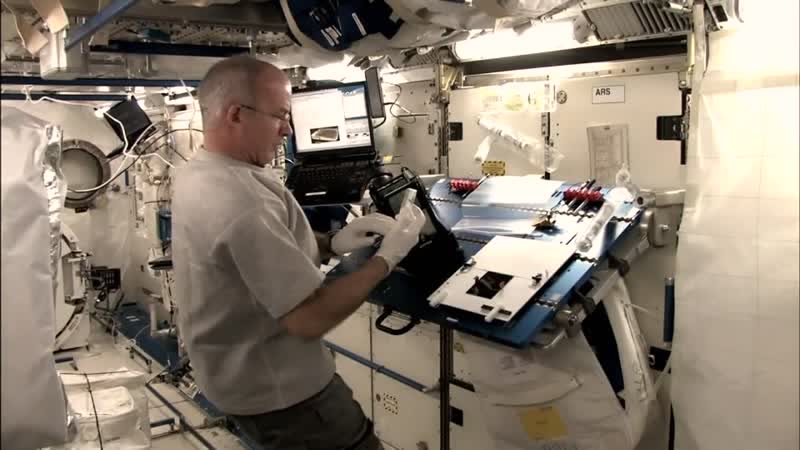
1:18For LMM, or the light Microscopy Module,
1:21we have one little containment
1:22within the auxiliary fluids container that is the glove box
1:26that contains the samples that are on the microscope.
1:30This contains frangibles,
1:31this will not contain your sample fluids.
1:35For the advanced colloids experiment,
1:37we seal your sample cells with either wax or viton plugs.
1:41These are then sealed with coverslips held by epoxy.
1:47We like to personalize the sealing methods
1:50for each PI sample fluid type due to compatibility issues
1:56and what the sample type is made of.
2:00Then, once the samples are sealed and cover slipped,
2:05we ship them to SpaceX in a vitron bag
2:09and they will be shipped to the International Space Station.
2:12For the advanced colloids experiment,
2:14you will be sending your sample compositions to me
2:16so I can evaluate whether or not they are properly meshed
2:20with our sealing methods.
2:22For example, many of the organic materials are not compatible
2:26with our wax.
2:29Other samples may be compatible with our viton plugs,
2:33or possibly for sealing through other methods.
2:38As a chemist and as an engineer, it's exciting
2:41to see how these samples react in the absence of gravity.
2:45It's amazing to see what this can do
2:48for technologies here on earth.
2:52Anything from cosmetics and shampoos to possible, you know,
2:57building blocks of future materials.
3:01Thank you for attending our session.
3:03If you'd like more information, you can visit our website,
3:05or you can meet us at our booth at the ASGSR.
3:09Thank you.
 ▶ Watch on Afoli
 Wood chopping1:42
 Testing the Dragonfly drone in the dunes2:25
 Sunset over Bangkok, timelapse4:53
 The Amazon canopy in laser data2:01
 A gas carrier transits Porpoise Bay2:40
 The Dog Factory (1904)4:29
 Hobby horse laughs6:41
 The rapids and falls of Ohiopyle2:56