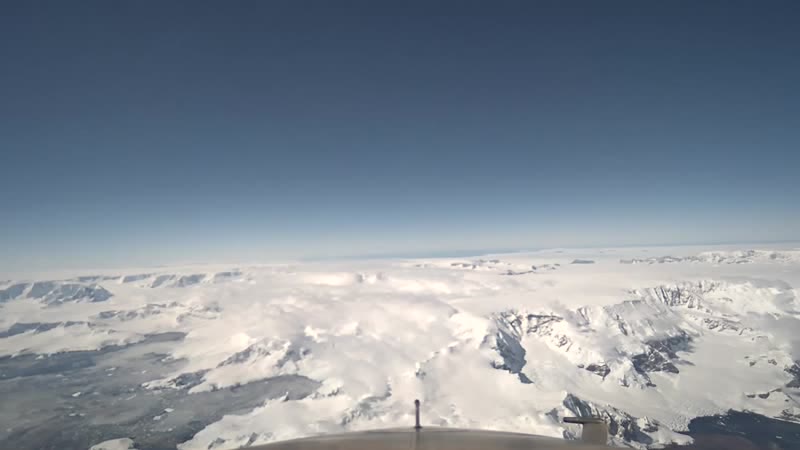
0:00Narrator: Antarctica is covered by the largest piece of ice on Earth.
0:04How that ice moves and changes affects
0:08the entire planet. A NASA airborne mission
0:12called Operation IceBridge is now completing its eighth consecutive year
0:16of measuring the changes in Antarctic ice. The science team uses
0:20the most comprehensive suite of instruments ever flown on long range flights,
0:24including lasers, radars, an infrared sensor,
0:29digital photography, and a gravimeter.
0:33The mission was born out of a need to bridge the gap in observations between
0:37NASA’s ICESat satellite, which ended its mission in 2009, and
0:41ICESat-2, scheduled for launch in 2018. This year
0:45IceBridge was able to fly two missions around the 88th parallel,
0:49to provide measurements at the southernmost edge of ICESat-2’s planned orbits.
0:53Many of IceBridge’s 24 science flights this
0:57year were focused on mapping the sea floor, where the Antarctic Ice Sheet
1:02meets ocean waters, so that scientists can better predict how fast
1:06the margins of the ice might melt. The mission also flew
1:10extensively over Antarctic sea ice, measuring extent and thickness
1:14of the frozen seawater. The team found coverage to be sparse
1:18in the Bellingshausen Sea — and as we know from satellite observations
1:22, sea ice coverage around the continent is currently at a record low
1:26for this time of year.Several missions around the Antarctic Peninsula
1:30also provided a wealth of data and some beautiful images.
1:34Of special interest was a flight over a growing crack in the Larsen C
1:39ice shelf. Once this crack is fully formed, it will produce
1:43an iceberg roughly the size of the state of Delaware.
1:47All of this year’s flights were based out of Punta Areas, Chile,
1:51but next year, IceBridge plans to fly out of McMurdo Station
1:55in Antarctica in order to hit a new range of important science targets
1:59and continue to shed light on how melting polar ice is contributing
2:04is contributing to sea level rise.
2:08[music fades]
 ▶ Watch on Afoli
 Wood chopping1:42
 Testing the Dragonfly drone in the dunes2:25
 Sunset over Bangkok, timelapse4:53
 The Amazon canopy in laser data2:01
 A gas carrier transits Porpoise Bay2:40
 The Dog Factory (1904)4:29
 Hobby horse laughs6:41
 The rapids and falls of Ohiopyle2:56