0:09[ Music ]
0:20>> As we send people on long-term missions farther
0:22and farther into space, on missions beyond low Earth orbit
0:26and the moon, we need to know more
0:28about the physiological risks in order
0:30to solve the considerable obstacles
0:32to human space exploration.
0:34Physiological problems such as weightlessness,
0:36immune system changes or bone loss during long-duration human
0:40exploration can be better understood
0:42in the microgravity environment aboard the ISS.
0:46These are studied and explored, together with the crew
0:48and the biological model systems.
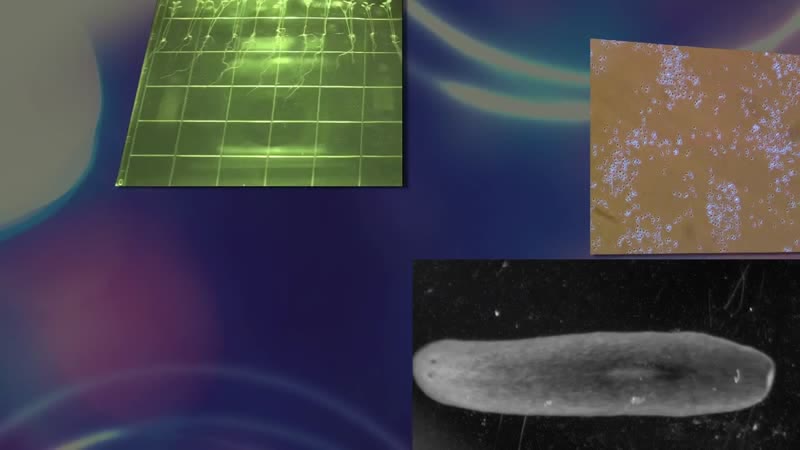
0:53Space biologists are also studying the role
0:55of earth's organisms, animals, plants and microbes
0:58in long-term life support systems and bio habitats
1:01in space or on planetary surfaces.
1:05[ Music ]
1:08>> Space biology is NASA's hypothesis-driven,
1:11discovery-based biological science in space
1:14and the associated technology that goes along with that.
1:16Human health is a very important part of space life sciences,
1:19and space biology is this discovery-based,
1:22animal and plant and cell research that leads
1:24to those new countermeasures for going beyond low Earth orbit.
1:28In space, cells do change,
1:31and we want to understand not just what's changing
1:34but how the proteins that are changing are working in the cell
1:37and how that's adapting and responding
1:38to the space environment.
1:40[ Music ]
1:43>> There are several microscopes onboard the ISS
1:46to aid space biologists in their investigations.
1:49The Light Microscopy Module, or LMM,
1:52has already helped physicists and engineers develop novel,
1:55advanced materials and improve consumer products,
1:58both for Earth and in space applications.
2:01The LMM is ready to provide a unique vantage point from which
2:04to study the effects of space on biology.
2:08Using a modified commercial Leica RXA laboratory microscope,
2:12the NASA Glenn Research Center has configured the LMM
2:15to allow real-time interaction and manipulation of experiments
2:19in space and ground-based controls.
2:21Interaction with the experiments is now routine,
2:25based on experience for staff, researchers
2:27and the in-flight ISS crew.
2:30The LMM is located inside the Fluids Integrated Rack
2:33of the U.S. Destiny Laboratory Module aboard the International
2:37Space Station.
2:37The FIR Rack provides the LMM
2:40with common laboratory infrastructure,
2:42including an optics bench, temperature control, power,
2:47illumination, imaging, data processing, and isolation
2:51from vibrations, so that high magnification images can be
2:54captured without jitter.
2:56[ Music ]
2:59The Light Microscopy Module uses the existing electronics
3:02of the Leica Microscope, supplemented with unique
3:05and innovative internal and external electronics
3:08to support remote operation,
3:10enhanced automation and superior imaging.
3:13Motors and linear actuators motorize the microscope's
3:16manual functions.
3:18Engineers at NASA Glenn Research Center equip the Leica
3:21with 23 micro-motors, which permit remote control
3:24by scientists on the ground
3:26and reduce ISS crew time requirements in space.
3:29This tends to increase the available time for research.
3:34Two identical high-resolution black
3:36and white cameras can be mounted on the headpiece --
3:39one coaxially in the viewing axis of the microscope.
3:42The other can be mounted at an angle in the tube assembly.
3:46Additionally, a small surveillance camera is available
3:48to be mounted inside the auxiliary fluids container,
3:52where sample cells are processed and contained.
3:55Imaging techniques include bright field
3:57and fluorescents, from 2.5 to 100x.
4:02The Flight LMM Microscope Fluorescence Turret has eight
4:06locations, which are occupied with the following filters:
4:09FITC, Texas Red, a polarizer, half-mirror, DAPI,
4:14a 50/50 beam splitter cube, red, blue and green.
4:19Plans are in development to reconfigure the filter turret
4:22by replacing the red, green and blue filters
4:24with a TRITC filter cube,
4:26mirror and the blank location for confocal use.
4:29The capabilities of the red,
4:30blue and green pseudo-color can be replaced
4:33with a color camera, when required.
4:37The LMM has previously imaged regular
4:40and specialty microscope slides, including petri dishes
4:43and Opticells, which allow oxygen transport
4:46through a membrane and provide for containment
4:48of the biological sample and the sample medium.
4:52>> The benefits for being able to view the experiment
4:55as it develops on orbit is huge, because they enable
4:59to see things as they are functioning, in the environment
5:02in which you're testing.
5:04Because by the time you get the plants back
5:06from orbit, they've changed.
5:08And so if you can't capture those images immediately
5:11or very soon while they're being challenged in the environment
5:14of the space station, you lose -- you lose those critical data.
5:17And so you really have to be able to view them in situ.
5:21[ Music ]
5:24>> The LMM can support five main areas of space biology
5:28with an orbit viewing of materials before gelling
5:30or freezing -- plant research, cell culture research,
5:35micro-organism research, invertebrate research,
5:39vertebrate research, macro-molecular biophysics.
5:44>> I am a NASA biomedical engineer and lea d developer
5:48of our VESGEN software.
5:50The fractal-based software maps
5:53and quantifies vascular remodeling for human, vertebrate
5:57and even invertebrate model systems.
6:00We're also associating with the geometric dynamic dimensions
6:04of vascular remodeling and blood flow
6:07with essentially unlimited numbers
6:09of bio-informatic dimensions.
6:11These informatic dimensions of localized protein
6:14and other molecular expression are captured
6:17by fluorescence microscopy that is available to you now
6:21on the LMM, for you space biology experiments,
6:25with confocal capabilities planned in the near future.
6:30These approaches are illustrated in our VESGEN mapping analysis
6:33of vascular tissues in ISS model organisms,
6:37that include the mouse GI and retina, fruit fly wings,
6:41vascular patterning and an Arabidopsis leaves,
6:44and even the human retina for our research
6:46on astronaut ocular and vision problems.
6:50We invite you to picture your space biology research,
6:53using the LMM and potentially other microscopes,
6:56manifesting in future ISS missions until 2024.
7:01[ Music ]
7:04>> Currently, the microscope offers backlighting
7:06and FE fluorescent illumination.
7:09High-resolution color video microscopy, dark field
7:12and phase contrast capabilities are also being developed.
7:15A commercial condenser has been proposed
7:18to provide bright field illumination.
7:20The FIR and LMM upgrades for a confocal scanner,
7:24a neodymium mag laser and faster digital cameras are manifested
7:28for 2016.
7:29This will enable 3D structures to be analyzed in more detail.
7:34>> Using the LMM for biology is a bit of a challenge.
7:38It's not designed for biology, per se.
7:41And so a scientist, a biological scientist,
7:44has to adapt the biology to be able to fit both operationally
7:49and physically into the unit.
7:50However, being able to view things in situ at this kind
7:54of level of resolution -- the microscopic level --
7:56also with fluorescence, is a huge advantage to most
8:00of the kind of biology that many of us do,
8:03and it's certainly worth the effort.
8:05>> Space biology experiments scheduled to be flown
8:07and observed in the LMM over the next several months include APEX
8:12III, or the Events Planned Experiments in Orbit,
8:15flying on SpX-5 and 6.
8:19Generally, there are 30-day docking periods
8:21that are available for space biology experiments,
8:24before the physics colloids experiments begin.
8:29>> The LMM can aid space biologists, physicists,
8:33chemists, engineers and graduate student researchers
8:36in achieving a better understanding
8:38of biological samples, colloids and other physical processes
8:42on the microscopic level.
8:45If you're planning a project that could benefit
8:48from in-flight observations and the Light Microscopy Module,
8:51there are several ways to proceed.
8:53You can use the CASIS Program, a NASA Research Announcement
8:57or contact your program executive at NASA headquarters
9:00to get on the flight manifest.
9:02[ Music ]
 ▶ Watch on Afoli
 Wood chopping1:42
 Testing the Dragonfly drone in the dunes2:25
 Sunset over Bangkok, timelapse4:53
 The Amazon canopy in laser data2:01
 A gas carrier transits Porpoise Bay2:40
 The Dog Factory (1904)4:29
 Hobby horse laughs6:41
 The rapids and falls of Ohiopyle2:56