0:01[Music]
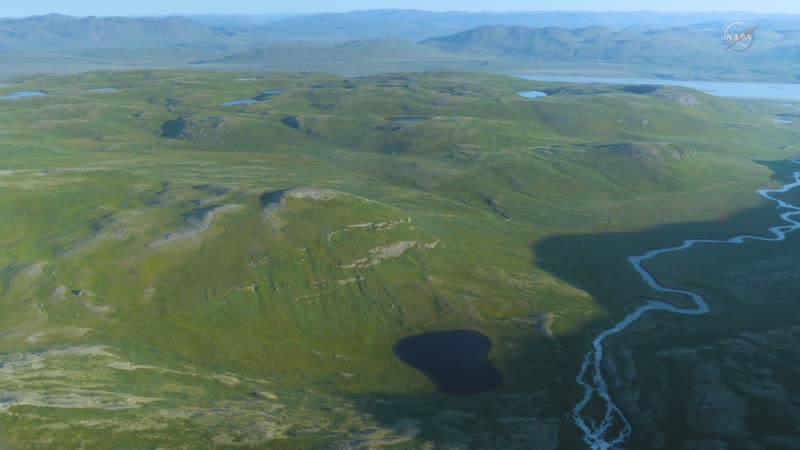
0:02Narrator: It is easy to imagine Greenland as a land of perpetual ice.
0:06However, scientists have recently estimated that the Greenland Ice Sheet may
0:09be gone within the millennium.
0:13Andy: My name is Andy Aschwanden, I am a Glaciologist with the University
0:17of Alaska, Fairbanks. I work at the Geophysical Institute.
0:20Narrator: Andy and his colleagues have used data
0:24collected by NASA to model some of the possible futures of the Greenland Ice Sheet.
0:27Andy: So, we see our projection
0:31of how the Greenland Ice Sheet will retreat
0:34over the course of the next roughly 300 years.
0:37It’s really cool that now we can actually watch
0:41in the animation, in the simulation, how we think it behaves.
0:45I mean, we put the best physics possible in there and we can
0:48actually watch what could happen. That is something we could not have done before.
0:52NASA’s Operation Ice Bridge
0:55over the past decade has been instrumental in gathering the
0:58datasets that help drive our model.
1:02Narrator: This model gives us a more accurate picture of how greenhouse gas
1:06emissions may affect Greenland - and us - in the future.
1:10Andy: Of the three scenarios that we tested there was one sort
1:14of a low emissions, medium emissions,
1:17and high emission scenario. And,
1:24at the moment, it looks like we’re on the highest scenario.
1:28The three different scenarios lead to
1:31basically three different futures, three different Greenlands.
1:34If we choose the path we are on right now,
1:38if we stay on that path, there is actually good chance that within 1000
1:42years or so, the whole Ice Sheet
1:45will be gone.
1:48Narrator: These scenarios show that the melting ice could contribute at least 80% more sea level rise than previous estimates.
1:55This model helps us understand the dynamic nature of the Greenland
1:57Ice Sheet, and arms us with the knowledge we need to inform our future.
 ▶ Watch on Afoli
 Wood chopping1:42
 Testing the Dragonfly drone in the dunes2:25
 Sunset over Bangkok, timelapse4:53
 The Amazon canopy in laser data2:01
 A gas carrier transits Porpoise Bay2:40
 The Dog Factory (1904)4:29
 Hobby horse laughs6:41
 The rapids and falls of Ohiopyle2:56